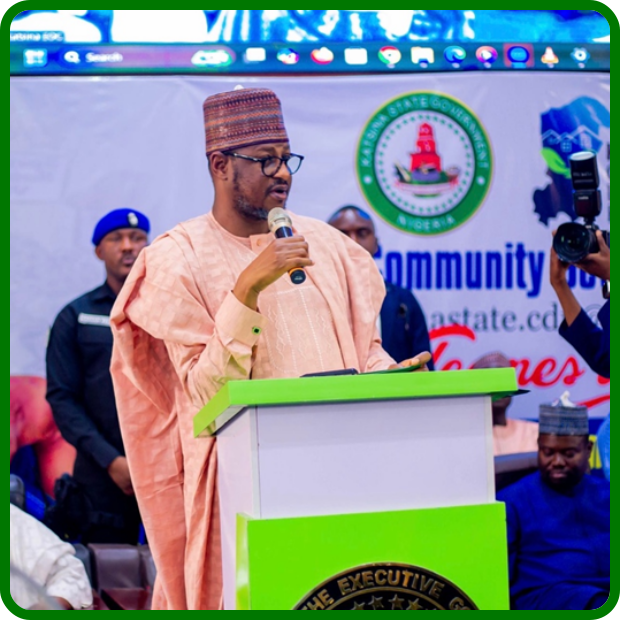
Distinguished Members of the State Executive Council, Honourable Members of the National and State Assembly, Respected Traditional Rulers, Esteemed Representatives of Development Partners, Members of the Press, Ladies and Gentlemen: It is both an honour and a privilege to address you today on a subject of profound importance to the future of Katsina State—the Katsina State Community Development Program. This initiative is more than just a policy; it represents a groundbreaking approach to development that leverages the insights and involvement of the communities it aims to uplift. We are embarking on a journey that not only seeks to meet our current developmental needs but also to pave the way for sustainable growth and empowerment for generations to come. The vision behind the Katsina State Community Development Program is simple yet ambitious: to transform Katsina State into a model of participatory governance and development. We recognize that sustainable change cannot be dictated from the top down but must be built from the ground up, guided by the voices and hands of those who live in the communities we aim to develop.
Our beloved Katsina State is rich in culture, tradition, and human potential. However, like many regions in Nigeria, our rural communities face persistent challenges. Healthcare facilities are often too far away, schools are under-resourced, and access to clean water remains a challenge. Our young people—our greatest asset—struggle to find opportunities for meaningful livelihoods and turn to counterproductive activities. Environmental degradation and climate change threaten our agricultural productivity, which is the backbone of many communities. We cannot wait for external solutions to address these issues. The solutions must come from within. And that is the foundation of this program: empowering communities to become the architects of their own development.
The essence of the Community Development Program lies in the belief that sustainable development is best achieved when communities are active participants rather than passive recipients. By involving communities directly in the planning, implementation, and monitoring of development projects, we aim to enhance relevance and effectiveness of projects because they will be tailored to the specific needs of communities are more likely to succeed and have lasting impacts. It will also promote ownership and sustainability because when communities have a stake in projects, they are more committed to maintaining and protecting them. It can strengthen transparency and accountability as community involvement serves as a check and balance, ensuring that resources are used appropriately. You do not have to take my words for it. In 2005, the Operations Evaluation Department, an independent unit in the World Bank which assesses what works and what doesn’t, published a comprehensive report on the effectiveness of World Bank support for community-based and community-driven development. The study found that Bank-supported community-based and community-driven projects have typically performed better on capacity enhancement—an important objective of the projects—when they have supported indigenously matured participatory efforts or when the Bank has provided sustained, long-term support to communities beyond the length of a single subproject. An extract from the report reads that in undertaking new CBD/CDD projects, the Bank should analyse whether it is building on existing local initiatives or starting a new program in a country and give priority to the former. In the latter case, the Bank should tailor the initiative to the country and community context and undertake selective, rigorous impact assessments of its projects before scaling up.
I do not reference the World Bank because its leadership in Nigeria is here but because no multilateral organisation has invested more in community-driven projects like the World Bank, and it has done so as a strategy as far back as 1979. As of June 2022, World Bank’s active Community Development Project Portfolio included 373 projects in 96 countries valued at approximately 42.4 billion dollars. In 2022 the Bank released an evidence-note on the performance of bank financed community development projects and the results remained largely positive. More specifically they found evidence that community-driven projects improve service delivery, poverty reduction, poverty targeting, participation, and social cohesion. The World Bank supported Community and Social Development Program (CSDP) in Nigeria was implemented in 29 of the 36 states and benefited 23 million people including our communities in Katsina State.
The United Nations Development Program (UNDP) has also undertaken successful community-based projects. In 2015, the Emergency Community Development Project in Senegal saw the government commit $200 million dollars and partnered with UNDP to help drive the project. Within 3 years its critics were convinced of the effectiveness of the project and the second phase financed by the African Development Bank will run until 2025. The interesting part is that the Senegalese government is now running the program in-house with capacity developed from the UNDP partnership. The UNDPs Program for Accelerated Community Development in The Gambia has also seen remarkable success. A review by renowned consulting firm Deloitte showed the positive impact of community-driven development projects in key sectors including agriculture, water and sanitation, education, healthcare, and transportation. In 2022, the UNDP launched the Accelerated Community Development Program in Liberia following a detailed feasibility study. The 100-million-dollar program received a 6 million dollar donation from the World Bank. The impact of the program has already been reported.
Around the world, there is increasing recognition that sustainable development is best achieved when communities are actively involved in shaping their own futures. Countries like India, Brazil, and Indonesia have demonstrated the power of Community-Driven Development (CDD) projects to deliver meaningful change. In India, the Mahatma Gandhi National Rural Employment Guarantee Act empowered rural households by providing wage employment for public works projects initiated and executed at the community level. In Brazil, community participation in the Bolsa Familia program helped improve education and healthcare outcomes by directly involving beneficiaries in planning and monitoring. In Indonesia, the National Program for Community Empowerment (PNPM Mandiri) supported thousands of villages in implementing infrastructure, education, and economic development projects driven by local needs and ideas.
These examples are proof that when communities are given the tools, resources, and autonomy to define their own priorities, they deliver results that are sustainable, inclusive, and impactful. It is this spirit of collaboration, empowerment, and accountability that inspires the Katsina State Community Development Program. Our community-driven development model has been carefully designed for sustainability with clear strategic objectives. The programs objectives include enhancing social cohesion and unity, economic empowerment, strengthening social support systems, promoting gender equity and human rights, improving access to basic infrastructure and public services, addressing socio-economic injustice, and environmental sustainability. Our research and examples from The Gambia and other countries show that integrating community-driven development with the fabric of governance and administration of public resources improves the chances of sustainability. We cannot afford to make this a one-off event or run it as a separate tool of our government. We are here to serve people in all communities and that is what we will set out to achieve. Our program has also been designed to reorganise how we have always done things to be more efficient and effective. We have not created new budgets or funds for this purpose alone. We are using existing local government staff as community officers, and we will invest in their capacity to deliver CDD projects in partnership with state ministries, departments, and agencies.
We have taken our model for community-driven development around Katsina in a series of townhall events where we engaged key stakeholders and members of various communities in interactive discussions about the program. I have presented the Community Development Program to all 34 local government chairmen and their key directors and sought their input in developing a sustainable model. I have also drafted the Katsina State Community Development Bill and passed it to the state assembly to ensure that we can enhance the sustainability of the program through legislative backing. It is important that the entire state architecture supports the community approach because we must all work together for it to succeed.
The core of our programme is driven by the committees we have established to guide implementation. The Program Steering Committee chaired by me will provide overall direction for the program and ensure that all the support and resources required are provided for success. The committee will include the commisoners for finance, budget and planning, local government affairs, education, health, water resources, and agriculture among others. The Joint Planning Committee which will be chaired by the deputy governor is a collaboration with the 34 local governments to ensure that their priorities and resources align with those of the state for community-driven development. Its composition will include local government chairmen, key commissioners, and the program coordinator. The Community Level Committees will be established in each community to ensure participatory governance and budget preparation as well as community-based implementation, monitoring and evaluation. The community officers in each community will form the community level committee in addition to representatives from the traditional institutions, religious organisations, women groups, market and farm associations, youth, and disabled persons. The thread that runs through our community development program is a dedicated Program Delivery Office which reports to the Program Steering Committee. The PDO will be led a program coordinator with the primary objective of ensuring that all ministries, departments, and agencies are aligned with the community-driven approach to budget implementation in Katsina State. The PDO will implement our robust monitoring and evaluation framework which will be digitally supported, and data driven. Our community officers will engage directly with the PDO to ensure effective implementation of all projects in the state
We have defined our communities by wards which are the smallest political unit of governance defined in Nigeria. A ward is led by an elected councillor and in Katsina state we have 361 wards in 34 local governments with an average population of 27,700 people. The wards in urban areas have a higher population while rural areas are much lower. We will establish one community development centre in each ward which will serve as the beacon of our community development program for that ward. The community centres will be responsible for engaging the communities and conducting needs assessments, project planning, resource mobilisation, and coordination. Our community centres will have 3 offices which are designed to meet specific objectives of the program. The Community Development Office will focus on infrastructure, access to basic services, socio-economic development, and overall development. The Community Support Office will focus on proving social care and support to members of the community especially our most vulnerable people in terms of cash transfers, healthcare, feeding, mental health, victim support, and dispute resolution. The Community Learning Office will focus on academic and moral learning opportunities, skills acquisition, and community orientation. Each office will have an officer from the local government staff who will be provided special training for their office. We have debated running the centre with one person performing all functions, but we are convinced we will not get the results we aim to achieve. The extensive research on the effectiveness of community-driven development by Casey 2018 found effective facilitators to be a major factor for the success and sustainability of CDD projects. 3 officers also give us a more democratic and transparent structure at the community level. We have already conducted an orientation program for all grade 8 to 10 local government staff and conducted a placement exam for over 1,300 staff. Our traditional community structures will be employed to provide an oversight for the community centres and also validate that all needs assessments, project prioritisation, and implementation reports meet the community participation guidelines.
The world is filled with examples of community-driven programs that have transformed lives. In Rwanda, community members participate in Umuganda, a monthly day of communal labour that has been instrumental in building infrastructure and fostering unity. In Thailand, community forestry programs allow rural villages to manage forests sustainably, balancing economic needs with environmental conservation. In Mexico, the PROGRESA program tackled poverty by linking cash transfers to community-led education and healthcare initiatives, breaking the cycle of intergenerational poverty. We have begun working on comprehensive standard operating procedures and reporting templates for the community development program. We will seek technical assistance from development partners to enrich our program. Many partners including the World Bank run various projects in Katsina state, and we are confident that the Katsina State Community Development Program will provide the data and effective monitoring and evaluation mechanisms to maximise the impact of the financing extended to the state. We can leverage our CDP model to ensure that all state project implementation units align their workplans with the needs and priorities of the communities selected for projects. Development partner projects will also complement government interventions in those communities while providing real time feedback from the beneficiaries. We urge all development partners to support this process as they design programs for Katsina state.
We plan to set up a community development fund where all communities will have access to some funding for minor projects. Our research has shown that extra budgetary activities like the repair of boreholes, fixing a leaking roof in a hospital, or providing emergency cash assistance to vulnerable persons can go a long way towards helping our people if we cut the bureaucracy. Our experience with AGILE has also demonstrated the power of giving communities resources to implement projects. All requests for cash or goods will be subject to program guidelines, community level committee approval and a participatory process. Our only condition is that communities must successfully complete a project before they can access additional funding. Ladies and gentlemen, as we launch the Katsina State Community Development Program, let us be reminded that development is not a gift—it is a collective effort. This program represents our belief in the potential of every community, every family, and every individual in Katsina State. I call on our traditional leaders to guide this process with wisdom, our local governments to support it with dedication, and our partners to enrich it with innovation. Most importantly, I call on our communities to embrace this opportunity and take ownership of their futures.
Today, we embark on a journey to transform our state, one community at a time. Let us work together to build a Katsina State where progress is not just a promise but a reality, where no one is left behind, and where every individual can live with dignity and hope. May Allah guide and bless this initiative and may Katsina State thrive as a beacon of community-driven development in Nigeria and beyond. Thank you, and may Allah bless us all”.